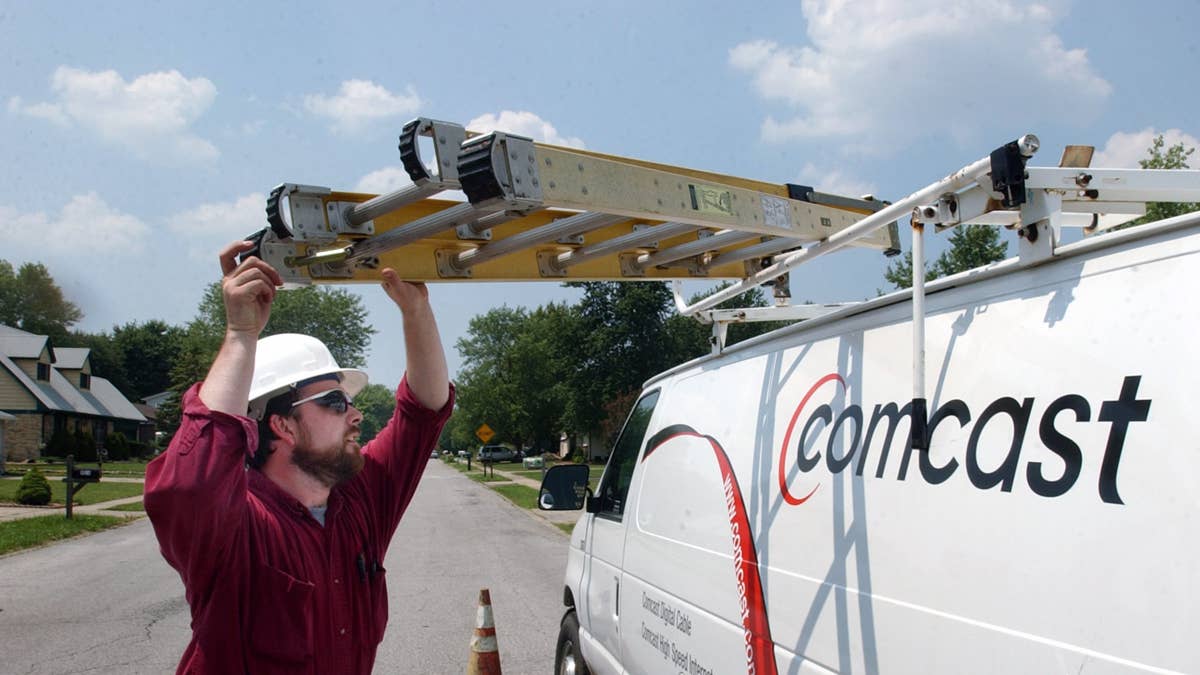
Comcast has been quietly contemplating acquiring a 33-year-old telecom competitor as it continues to struggle with customer losses in its cable TV and internet business.
The company lost 322,000 cable TV customers and 65,000 internet customers in the first quarter of 2026 as it faces growing competition, according to its most recent earnings report.
Amid a decline in customers, Comcast raised eyebrows last month when it announced its plans to split into two companies by separating its media and entertainment assets, including NBCUniversal and Sky, from its core broadband, wireless, and cable TV operations.
In a press release, Comcast Co-CEO Brian Roberts said the split will better position the companies to pursue “significant opportunities that lie ahead.”
“The transaction we are announcing will unlock a more entrepreneurial management approach and open up a multitude of new opportunities for each business,” said Roberts.
Comcast weighs Charter Communications acquisition
One of those potential opportunities reportedly involves Comcast acquiring Charter Communications, according to a report from the New York Post.
Comcast has long contemplated this acquisition; however, “debt” is what’s causing the company to hesitate on initiating the deal.
Roberts isn’t interested in taking on another roughly $100 billion in debt while he’s in the middle of organizing a widespread corporate restructuring.
Last year, Comcast sent a memo to employees revealing that its restructuring plans would kick off in January this year, resulting in massive job cuts that would impact employees in its Xfinity internet, mobile, and cable TV business.
These restructuring plans now also include Comcast separating into two publicly traded companies.
Related: Spectrum makes significant decision as customer losses mount
It is no surprise that Roberts is worried about debt. According to an analysis from The Motley Fool, Comcast has a total debt of $94.61 billion.
Charter, which launched in 1993 and introduced its Spectrum brand in 2014, revealed in its first-quarter 2026 earnings report that its principal amount of debt is $94.3 billion. The company is also in the middle of a $34.5 billion acquisition of Cox Communications, which is expected to help Charter offset customer losses in its broadband and cable TV businesses.
Despite their billions in debt, both Comcast and Charter have sufficient cash flow. Comcast has around 2.3 times EBITDA (the amount of money a company makes before expenses) to cover its debt, compared to Charter’s, which is at about 5 times.
While a merger between Comcast and Charter could help both companies better address rising competition in the telecom industry, it would likely prompt an antitrust review amid concerns that less competition could lead to reduced innovation and higher prices for consumers.
In a recent analyst note obtained by Fierce Network, New Street Research analyst Vikash Harlalka said he and his firm believe a Comcast-Charter merger could be “transformative for both companies.”
“We continue to believe that a Comcast-Charter merger should and can happen,” said Harlalka. “The industrial logic and synergies would be transformative for both companies.”
“Not least among these would be the potential to acquire at least a 50% share of T-Mobile and create the country’s third converged player to stand up to AT&T and Verizon in a facilities-based way,” he continued.
Streaming continues to threaten Comcast and Charter
The potential Comcast-Charter acquisition also comes at a time when Americans are increasingly pulling the plug on traditional cable TV and internet services.
In the first quarter of 2026, cable and satellite TV companies lost about 976,000 cable customers, according to a MoffettNathanson report shared with TheStreet.
More Telecom News:
- T-Mobile warns customers that a key service will double in price
- Verizon adds generous offers for customers after price increase
- Spectrum suffers heavy loss as customers ditch service
The rise of streaming services in recent years has made it hard for traditional TV providers, like Comcast and Spectrum, to compete for customers, especially when it comes to pricing.
A survey from All About Cookies last year found that only 30% of Americans watch TV through traditional cable or satellite services. Also, 95% of those who canceled their traditional TV services are satisfied with their decision, while only 5% regret it.
“Rising cable costs and the thousands of options for shows and movies on various streaming services have been key factors in the popularity of cord-cutting,” wrote All About Cookies Data Journalist Josh Kobert and Senior Digital Security Editor Kate Quinlan in the survey release.
“As long as streaming subscriptions are more affordable than cable for the average household, it makes sense to move away from cable.”
Comcast and Charter struggle to compete with internet rivals
U.S. consumers are also cutting the cord on traditional internet services and flocking to fiber and fixed wireless internet (FWA) options.
Fiber internet has gained traction in recent years by delivering faster, more consistent connections that often surpass those of traditional wired internet.
Meanwhile, fixed wireless internet, often marketed as 5G home internet, has also emerged as a formidable competitor in the broadband industry. The service typically costs less than many wired internet plans and has expanded internet access in rural and underserved communities.
Wireless providers such as T-Mobile, AT&T, and Verizon all offer both fiber and fixed wireless internet services, which are successfully drawing in customers at a rapid pace, especially through converged mobile and internet offerings.
In the first quarter of 2026, all three carriers collectively gained over 1.4 million new internet customers, according to numbers pulled from their latest earnings reports.
Another rising threat to Comcast and other traditional internet providers is satellite internet. SpaceX’s satellite internet service, Starlink, launched in 2019, is quickly gaining customers.
In December last year, the company revealed on social media platform X that it has more than 9 million active customers.
Amazon also plans to start offering high-speed satellite internet through its Amazon Leo service, which is expected to launch later this year.
During an earnings call in April, Comcast Co-CEO Michael Cavanagh said the company expects competition in the broadband industry to remain challenging.
“Fixed wireless continues to market aggressively across our footprint, fiber overbuild is moving at a rapid pace, and promotional convergence offers remain elevated,” said Cavanagh. “We are not assuming this gets easier anytime soon.”
He also said that the company is responding to this reality by “investing to compete effectively, whether it is against fixed wireless, fiber, or any other alternative such as satellite.”
“To do this, we are staying focused on what we can control and what matters most to consumers: exceptional connectivity powered by the most reliable Wi-Fi, best-in-class products, and a simpler, more transparent experience that is easy to buy, activate, and support,” he said.
Related: Comcast targets frustrated T-Mobile customers with free offer